

Introduction
Modern life often feels crowded with assignments, meetings, goals, deadlines, and daily responsibilities. People can remain busy for hours yet make little progress when their actions lack a clear direction. Pentachronism offers a structured solution by dividing planning into five connected time levels. The method links long-term goals, milestones, weekly priorities, daily tasks, and regular reviews. Pentachronism can help students prepare for exams, workers manage projects, business owners meet deadlines, and individuals develop useful habits. This guide uses practical examples and simple tables to show how future goals can guide today’s actions.
What Does Pentachronism Mean?
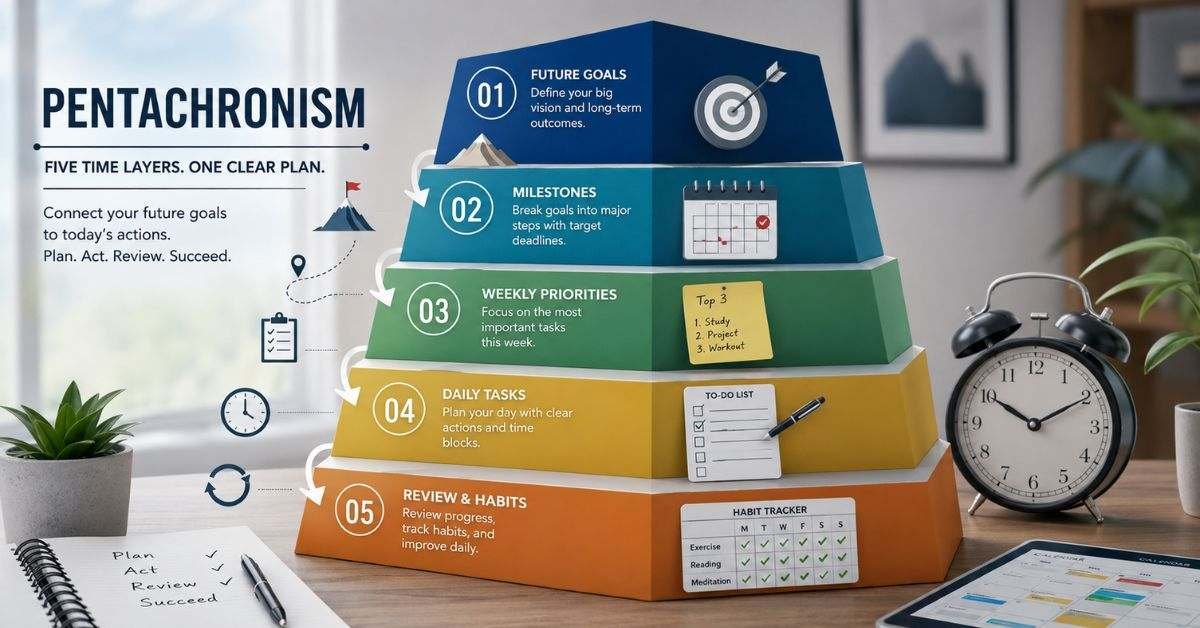
Pentachronism is a five-level approach to organizing time. It is not a fixed scientific theory, but it can be used as a practical planning framework.
The five levels are
- Future direction
- Important milestones
- Weekly priorities
- Daily actions
- Progress reviews
The future goal shows where you want to go, while the daily action explains what to do now. Pentachronism connects both sides so that small tasks support a meaningful result.
Why This Method Is Useful
Some people create yearly goals but never divide them into smaller steps. Others write long daily lists without checking whether those tasks support anything important.
Pentachronism can help users
- Turn large goals into manageable steps
- Set realistic deadlines
- Focus on valuable weekly work
- Reduce forgotten tasks
- Build steady routines
- Improve plans through review
The main benefit is clarity. What matters next is immediately apparent.
The Five Time Levels
| Time level | Main question | Common period | Example |
| Future direction | What result do I want? | 3–12 months | Pass a final exam |
| Milestones | What stages must I finish? | Monthly | Complete each subject |
| Weekly priorities | What matters this week? | Seven days | Finish two chapters |
| Daily actions | What will I do today? | One day | Study for 45 minutes |
| Review | What worked or failed? | Daily or weekly | Change the study time |
Pentachronism works best when every daily task supports a weekly priority and every weekly priority supports a larger milestone.
Choose a Clear Future Goal
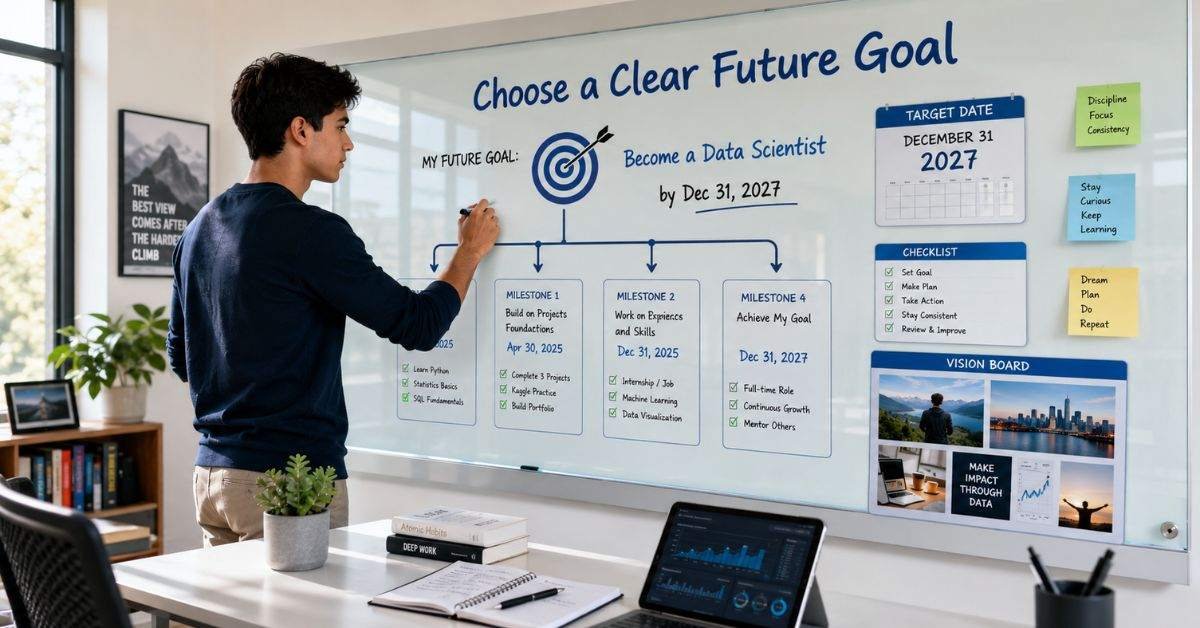
Determining your goals is the first step. “Be more successful” is hard to quantify. “Complete a six-part design course by October 2026” is much clearer.
A useful goal should include
- One clear result
- A realistic deadline
- A reason it matters
- A simple measure of success
Choose only one or two major goals at first. In pentachronism, the future direction acts like a map and helps you reject low-value tasks.
Divide the Goal Into Milestones
Viewing a major goal as one large job can make it feel overwhelming. Milestones make it easier by dividing the work into smaller stages. Someone building a website could choose the layout, write the content, build the pages, test the site, and publish it. Each stage needs a result, deadline, and a little spare time for delays.
Set Weekly Priorities
Weekly planning transforms milestones into manageable tasks for the present. At the beginning of each week, review deadlines, appointments, classes, and available hours.
Ask these questions
- Which deadline is closest?
- Which task creates the most progress?
- How many working hours are available?
- What can be delayed or removed?
- Where is extra time needed?
Choose three to five important outcomes. With Pentachronism, weekly plans must match your real capacity. Ten hours of work cannot fit into five free hours.
Plan Clear Daily Actions
Daily tasks should be direct and easy to begin. “Study history” is unclear. A clear action is provided by “Read chapter three and write five revision notes.” Assign each important task a starting time, ending time, and expected result. Leave space for rest, messages, travel, and unexpected problems. Pentachronism is not about completing the largest number of tasks. It involves finishing the appropriate tasks in the proper sequence.
Connect Habits With Goals
Goals describe results, while habits describe repeated behavior. A deadline creates urgency, but a routine creates steady progress. A student who wants to improve English writing could say, “After breakfast, I will write for twenty minutes at my desk.” Choose a habit that is easy to repeat, linked to a goal, and possible on busy days. Missing one day is not failure, but repeated missed days may show that the routine needs changing.
Review and Improve the Plan
Review is the final level and one of the most important parts of the system. Without it, people might stick to a plan that isn’t working.
| Review question | Example answer | Useful change |
| What was completed? | Two lessons and one test | Continue the plan |
| What was delayed? | Presentation notes | Start one day earlier |
| What caused difficulty? | Phone distractions | Keep the phone away |
| What needs more time? | Mathematics practice | Add two sessions |
At the end of each week, check completed tasks, missed deadlines, habits, and upcoming work. Pentachronism uses review as feedback, not punishment.
A Real-Life Example
Imagine a student who wants to score at least 80 percent on an October 2026 mathematics exam. Completing algebra, geometry, and revision are the benchmarks. The weekly priority is finishing two lessons and one practice test. The daily action is studying for 45 minutes three times a week. The review happens every Sunday. This example shows how pentachronism connects daily effort with the final result.
Common Mistakes to Avoid
A planning system should make life easier, not more complicated. Avoid these mistakes:
- Managing too many major goals
- Treating every task as urgent
- Planning without spare time
- Using several apps for the same job
- Moving unfinished tasks without reviewing them
- Tracking habits that do not support a goal
One calendar, one task list, and one weekly review page are enough for most people.
FAQs
Is pentachronism a scientific theory?
No. It is best understood as a practical five-level planning framework.
Can students use this method?
Yes. It can connect exam goals with weekly lessons and daily study.
How often should a plan be reviewed?
A short daily check and one weekly review are usually enough.
Is a special app required?
No. A notebook, spreadsheet, task app, or calendar can work.
How many goals should be planned at once?
Start with one or two important goals.
Conclusion
Effective time management is not about staying busy all day. It is about making sure that daily effort leads toward a meaningful result. Pentachronism provides a clear structure by connecting future goals, milestones, weekly priorities, daily actions, habits, and reviews. The method can support school, work, business, health, and personal development without losing sight of future results. Choose one goal for 2026. Divide it into smaller milestones, select one weekly priority, and schedule one clear action for today. Test the method for seven days, review your progress, and improve the plan using real results.