

Introduction
Nature doesn’t always invent new weapons, sometimes it steals them. One of the most intriguing survival mechanisms in evolutionary biology is kleptotoxicity. Instead of producing toxins themselves, certain animals acquire toxic compounds from their diet or environment, store them safely in specialized tissues, and deploy them as chemical defenses against predators.
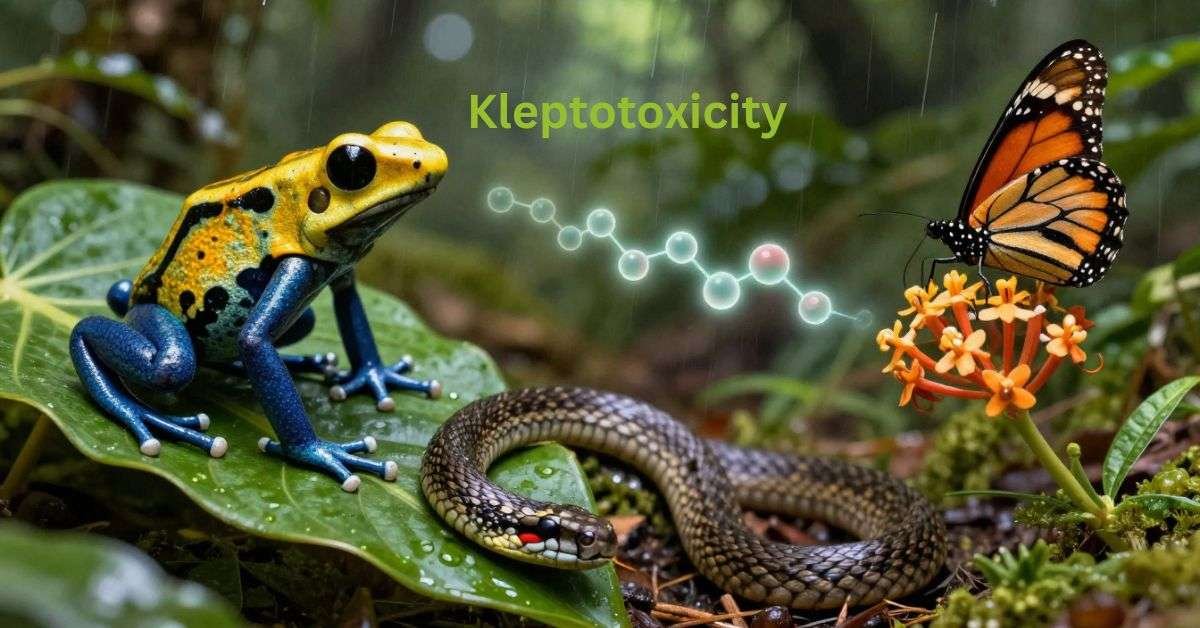
This process, often called toxin sequestration or diet-derived chemical defense in scientific literature, reveals something powerful: defensive chemistry can move through food webs. From poison dart frogs and Asian keelback snakes to monarch butterflies and marine nudibranchs, kleptotoxic species turn their prey’s chemistry into their own biological armor.
What Is Kleptotoxicity?
Kleptotoxicity is a biological strategy in which an organism acquires toxic chemicals from another species, usually through diet, and stores them for defense.
The word combines
- Klepto = to steal
- Toxicity = poison
Unlike venomous animals (which synthesize toxins internally), kleptotoxic species rely on external sources of chemical defense.
In research papers, scientists often use terms like:
- Chemical sequestration
- Diet-derived defense
- Acquired chemical defense
- Toxin trafficking in food webs
All refer to the same underlying principle: toxins can move between species.
How Kleptotoxicity Works in the Body

Kleptotoxicity is not simply “eat toxic things → become toxic.”
It requires a highly coordinated physiological system.
Resistance
The animal must evolve resistance to the toxin’s effects. This may involve:
- Modified receptor proteins
- Detoxification enzymes
- Target-site mutations
- Binding proteins that neutralize toxicity
Without resistance, the toxin would kill the carrier.
Uptake and Transport
After ingestion, toxins must:
- Cross the gut lining
- Enter circulation
- Avoid damaging vital organs
Recent molecular studies (2024–2026) suggest transporter proteins play a critical role in safely trafficking alkaloids and steroid toxins through tissues.
Safe Storage
Toxins are typically stored in:
- Skin glands (poison dart frogs)
- Nuchal glands (Rhabdophis snakes)
- Body wall tissues (nudibranchs)
- Feathers and skin (Pitohui birds)
Compartmentalization prevents self-poisoning.
Deployment
The toxin is released when:
- A predator bites
- Skin is compressed.
- Defensive posture exposes toxin-rich glands
This integrated system makes it a complex evolutionary adaptation, not a simple trick.
Strong, Evidence-Based Examples of Kleptotoxicity
Rhabdophis tigrinus (Asian Keelback Snake)
One of the most scientifically validated examples.
- Eats toxic toads
- Sequesters bufadienolide steroids
- Stores them in specialized nuchal glands
Feeding experiments and island population studies show:
- Snakes without toads in their diet lack bufadienolides.
- Chemical profiles match local prey availability
This is textbook diet-derived chemical defense.
Poison Dart Frogs (Family: Dendrobatidae)
Often misunderstood as toxin producers.
In reality:
- They obtain many alkaloids from ants, mites, and beetles.
- Store them in skin glands
- Pair toxicity with bright warning colors (aposematism)
Key evidence:
- Captive frogs without wild prey often lose toxicity.
- Alkaloid diversity mirrors diet composition
This demonstrates chemical flow from arthropods to frogs to predators.
Monarch Butterflies
As caterpillars, monarchs feed on milkweed. Milkweed contains cardiac glycosides (cardenolides).
Monarchs:
- Tolerate these compounds
- Store them in tissues
- Become toxic to birds
Predators that attempt to eat monarchs often vomit and avoid them later.
Nudibranchs (Marine Sea Slugs)
In marine ecosystems, It is widespread.
Nudibranchs:
- Feed on toxic sponges, hydroids, or cnidarians
- Retain or modify secondary metabolites
- Store them in body tissues
Some species also practice kleptocnidae, stealing stinging cells from jellyfish. Marine chemical ecology research shows that defensive chemistry often mirrors dietary sources.
Kleptotoxicity vs. Venom vs. Poison
| Feature | Venomous Animals | Poisonous Animals | Kleptotoxic Animals |
| Produces toxin internally | Yes | Often | No (or partially) |
| Acquires toxin from diet | No | Rarely | Yes |
| Delivery method | Injection | Contact / ingestion | Contact / ingestion |
| Example | Cobra | Cane toad | Monarch butterfly |
Important distinction:
It describes the source of toxins, not the delivery method.
Why Kleptotoxicity Evolves
Evolution favors strategies that increase survival and reproductive success.
Advantages
- Saves metabolic energy
- Uses already-evolved chemical defenses
- Allows rapid ecological adaptation
- May reduce need for complex biosynthetic pathways
Trade-Offs
- Dietary specialization
- Dependency on toxic prey
- Vulnerability if prey disappears
- Costs of resistance and storage mechanisms
If ecosystems change, kleptotoxic species may lose protection.
Ecological Importance: Toxins Move Through Food Webs
It reveals that ecosystems function as chemical networks.
Toxins can flow:
Plant → Insect → Frog → Snake → Bird
When climate change, pesticides, or habitat destruction disrupt one link, defensive systems can collapse.
This has implications for
- Predator-prey dynamics
- Species survival
- Biodiversity conservation
- Ecosystem resilience
What Scientists Are Studying Now
Recent research trends include
- Genomic studies identifying resistance genes
- Proteomic analysis of toxin-binding proteins
- Climate-driven changes in plant chemical profiles
- Evolution of toxin sequestration across phylogenies
- Biotechnological applications of natural toxin transport systems
Advanced mass spectrometry now allows precise tracking of chemical flow between species. It is increasingly recognized as a major theme in chemical ecology and evolutionary biology.
Medical and Biotech Relevance
Understanding how animals safely handle toxic compounds may help:
- Improve targeted drug delivery
- Develop antidotes
- Create safer pharmaceuticals
- Inspire synthetic biology innovations
Cardiac glycosides, alkaloids, and steroid toxins studied in kleptotoxic systems have already influenced medicine. Nature is a biochemical engineer, we are learning from it.
FAQs
What is kleptotoxicity in simple terms?
It is when an animal steals toxins from another organism, usually through diet, and uses those toxins for defense.
Do kleptotoxic animals produce their own poison?
Typically no. They rely on diet-derived toxins rather than internal synthesis.
What is the best example of it?
The Asian keelback snake (Rhabdophis tigrinus), which stores bufadienolide toxins from toads in specialized neck glands.
Are poison dart frogs born poisonous?
Not fully. Many acquire their alkaloid toxins from specific arthropods in their natural diet.
Why is It important?
It shows how chemical defenses move through food webs and how species survival depends on ecological interactions.
Conclusion
Kleptotoxicity demonstrates that evolution is not just about invention, it’s about strategic reuse. By acquiring, storing, and weaponizing toxins from other organisms, animals like snakes, frogs, butterflies, and sea slugs transform ecological relationships into survival tools. This strategy connects physiology, evolution, ecology, and conservation into one powerful concept: chemistry flows through life.
As research expands in 2026 and beyond, It is emerging as one of the most compelling examples of how interconnected, and chemically sophisticated, natural systems truly are.